
The "Scent-Sational" Trap:
Engineered Persistence
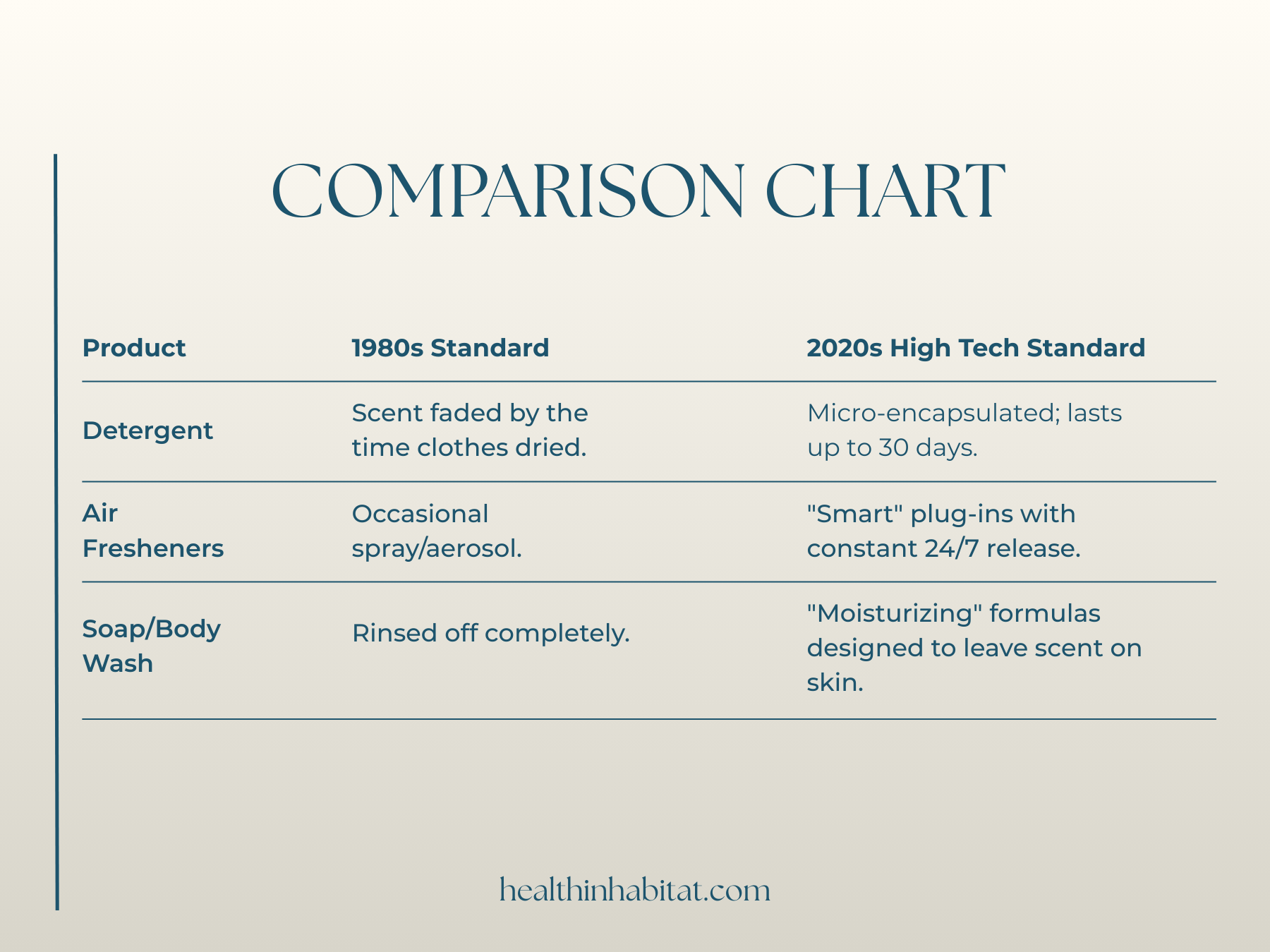
In the past, a fragrance was a top note that evaporated. Today, laundry and personal care brands use micro-encapsulation technology. These are microscopic plastic polymer bubbles that trap fragrance and "burst" over time as you move or touch the fabric.
"If you can smell your laundry detergent on your clothes three days after they were washed, you aren't wearing 'clean' clothes—you’re wearing a chemical film. Modern fragrance is engineered to stick to fibers and skin using these plastic micro-encapsulants and phthalate fixatives. This creates a 24/7 'dosage' of hormone-disrupting chemicals that your body must work overtime to detoxify. In a 'Dumb Home,' we don't just clean the air; we clean the products that touch your skin." - Health in Habitat
1. Laundry: The 24/7 Exposure Loop
Laundry products are the biggest offenders because of the surface area involved.
The "Freshness" Lie: Modern detergents and fabric softeners are designed to stay in the fabric for up to 30 days. This means you are breathing in and dermally absorbing endocrine disruptors (EDCs) while you sleep (sheets), while you work (clothes), and after you bathe (towels).
The Dryer Vent Effect: Scented laundry products release over 25 volatile organic compounds (VOCs) through dryer vents, many of which are classified as hazardous air pollutants. You aren't just scenting your clothes; you are polluting your entire neighborhood’s air.
The Phthalate Fixative: To make that "Spring Rain" scent last for weeks, manufacturers use phthalates as fixatives. These chemicals are known to mimic estrogen and have been linked to lowered sperm counts and altered thyroid function.
2. Personal Care: Bioaccumulation on the Skin
Your skin is your largest organ, and it is highly permeable.
Haircare: Shampoo and "hair perfumes" are often high in siloxanes and parabens. Because these are applied near the nose and the heat of the shower aerosolizes them, they are both inhaled and absorbed.
The "Trade Secret" Barrier: Because "Fragrance" is legally considered a trade secret, a single bottle of "natural" body wash can contain hundreds of undisclosed chemicals, including synthetic musks (xenoestrogens) that accumulate in human fat tissue over time.
3. Why it’s Worse Now Than Ever Before
Cumulative Load: We used to have one "scent"—maybe a perfume. Now, the average person "layers" 10–15 fragranced products before they leave the house: detergent, softener, dryer sheets, body wash, shampoo, conditioner, deodorant, lotion, and hair spray.
The Rise of "Super-Scents": Market trends show that consumer demand for "long-wear" claims has tripled since 2019. This push for "longevity" requires stickier, more aggressive chemical stabilizers that the human endocrine system simply hasn't evolved to process.
Don’t get "greenwashed" by clever marketing claims and fancy packaging.
The Fragrance-Free Transition Guide: How to Read a Label
"Unscented" and "Fragrance-Free" are not the same thing. Unscented products often contain "masking fragrances"—chemicals used to hide the smell of other chemicals. To truly detox your home, you need to look for specific red-flag ingredients.
🚫The "Big Three" to Avoid
If you see these on a bottle of laundry detergent, shampoo, or lotion, it is an automatic "No" for a detoxified home:
Fragrance / Parfum / Aroma: These are "catch-all" terms. Legally, a company can hide 300+ chemicals under this one word without disclosing them.
Phthalates (DEP, DBP, DEHP): These are the "fixatives" that make the smell stick to your clothes for weeks. They are heavy-hitting endocrine disruptors.
Quaternium-15 & Formaldehyde Releasers: Often found in "long-lasting" scented laundry soaps; these are respiratory irritants and known carcinogens.
Ingredient Red-Flag List (The "No" List)
Keep this list on your phone for your next trip to the store. If these words appear, the product is likely impacting your indoor air quality:
Limonene / Linalool: (Even if "natural," these react with indoor ozone to create formaldehyde).
Synthetic Musks: (Look for Galaxolide or Tonalide—these bioaccumulate in human tissue).
Methylisothiazolinone (MI): A common preservative in scented "natural" soaps that is a potent skin allergen.
Ethanolamines (DEA, TEA, MEA): Used to adjust pH in fragranced cleaners; can react to form cancer-causing nitrosamines.
The "Safe" Transition Strategy
Transitioning doesn't have to happen overnight. Use this 3-Step Swap method:
Step 1: The Textiles (Highest Impact)
The Swap: Replace scented detergent and fabric softeners with 100% fragrance-free versions (look for the "EWG Verified" seal).
The Hack: Use Wool Dryer Balls instead of dryer sheets. They reduce static and drying time without the chemical film.
Step 2: The Air (Immediate Relief)
The Swap: Toss all plug-ins, scented candles, and "room sprays."
The Hack: If you miss the ritual, use a high-quality HEPA air purifier with a thick activated carbon filter. It actually removes odors rather than masking them.
Step 3: The Personal Care (Direct Absorption)
The Swap: Move to "Fragrance-Free" (not just unscented) lotions and body washes.
The Hack: If you must have a scent, use a 100% organic hydrosol or a diluted essential oil only on the ends of your hair—never on the skin or aerosolized into the room.
💡The Tip to take Away
"If a product claims to have 'long-lasting freshness' or 'scent-burst technology,' it is a biological red flag. In a healthy home, the only thing you should smell is... nothing. Clean has no scent." - Health in Habitat