
The Frequency of Fabrics
Light, Sound, and… Fabric?
In a biologically designed home philosophy, we understand that everything is energy. We audit our blue light and our Wi-Fi, but textiles have their own "signature" too.
The "Signature" of Fabrics: The 1993 Nobuo Shioya Study
The concept of fabric frequency often stems from a study by Dr. Heidi Yellen (utilizing the work of Dr. Nobuo Shioya), which measured the "mHz" (millihertz) frequency of various fibers. The theory suggests that every material has a resonant frequency, and when we wear fabrics that align with the human body's frequency, we can feel energized. When we wear those that clash, we can feel depleted.
This study was conducted using the Ag-Environ Digital Spectrum Analyzer, invented by Bob Graham (Agricultural Engineering, Texas A&M) in 2003.
Here is how the measurement worked:
Oscillation Measurement: Every molecule in a material vibrates. In physics, this is called "atomic oscillation." The spectrum analyzer was used to measure the electromagnetic frequencies (in millihertz) emitted by various fibers.
The "Healthy Human" Baseline: The study established that a healthy, living human body has a baseline frequency of approximately 100 mHz.
The Textile Comparison: The researchers then measured the frequency of various fabrics to see how they compared to that human baseline.
The results were staggering: When compared against the human body holding an average frequency of 100 mHz., certain fabrics can either amplify that energy or ground it into the dirt. Here are the primaries.
1. The "Super-Fibers": Linen and Wool
According to this research, Linen and Wool are the powerhouses of the textile world.
The 5,000 mHz Signature: Both linen and wool were found to have a frequency of approximately 5,000.
The Catch: They are "opposite" signatures. If you wear them together, they cancel each other out (collapsing to near zero), which is why ancient traditions often forbade mixing linen and wool in a single garment (Deuteronomy 22:11 and Leviticus 19:19).
Why it works: Linen is highly conductive and has been used for centuries in healing (think of linen bandages). It is a "breathable" fiber that allows the body's electric field to flow naturally.
2. The "Neutral" Ground: Organic Cotton
The 100 mHz Signature: Organic cotton is considered "grounded" or neutral. It matches the average frequency of a healthy human body.
The Benefit: It doesn’t necessarily "boost" your energy, but it doesn't drain it either. It’s the perfect baseline for a healthy home.
3. The "Junk Food" of Fabric: Synthetics
Just as we have Junk Food, and Junk Light, we have Junk Fabric.
Polyester, Acrylic, and Nylon: These materials are essentially plastic. Their frequency is often measured near zero, or even in the negatives relative to human health.
The Biological Impact: Synthetic fabrics are "insulators" in the worst way. They trap static electricity and prevent the skin from "breathing" or exchanging ions with the environment. Wearing polyester is like wrapping yourself in a plastic bag, It suffocates your skin’s electrical exchange.
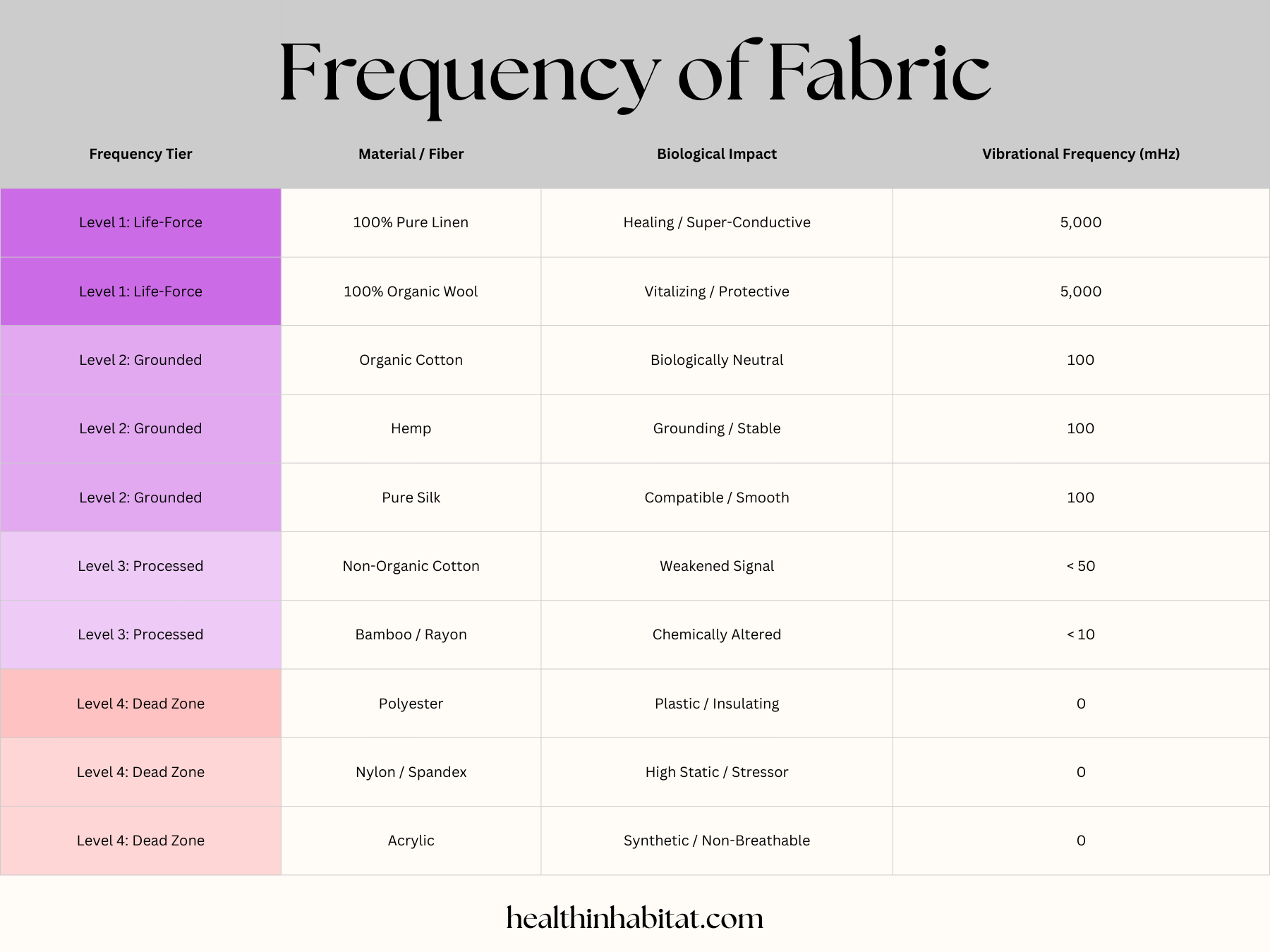
Just like food, the fabric we choose can raise our vibration or lower it.
Are You Sleeping in a "Dead Zone"?
We spend a third of our lives horizontal. We invest in high-end mattresses and weighted blankets, yet we overlook the one thing in direct contact with our largest organ, our skin, for eight+ hours every night.
The vibrational frequency of our bedding.
If you wake up feeling "static-y," unrefreshed, or physically heavy, it might not be your sleep cycle. It might be your "Wearable Battery."
If your sheets "crackle" when you move or cling to your legs, you are sleeping in a dead zone. This isn't just about comfort; it's about biological congruence. Your body uses sleep to repair DNA and flush toxins from the brain. To do that efficiently, it needs a conductive, natural environment. Synthetic fabrics act like a "grounding strap" for your vitality, draining your battery before you even wake up.
3 Steps to a Fabric Detox
The Pillowcase Pivot: Start where your brain is. Swap your synthetic pillowcase for 100% Linen or Organic Cotton tonight.
Ditch the "Microfiber": If the label says "polyester," it’s plastic. It belongs in the recycling bin, not on your bed.
Choose "Grounded" Cotton: If Linen is out of reach, choose 100% Organic Cotton. At 100 mHz, it perfectly matches the human body, providing a neutral, "safe" haven for rest.
The Consultant’s Take
"Your bed should be a charging station, not a drain. If you wouldn't wear a plastic bag to work, don't sleep in one for eight hours a night. Choose fibers that breathe with you."